
Elvis (2022)
- Molly Mortimer

- Feb 17, 2023
- 3 min read
Dubbed the ‘King of Rock’, Elvis Presley is a man who throughout his life was immensely successful but plagued with misery and misfortune up until his death in 1977. He left behind a monumental and unsurpassable legacy, becoming an American icon with his career spanning across industries and decades. The life of this significant cultural icon is the focus of director Baz Luhrmann’s newest film since 2013’s “The Great Gatsby”. Luhrmann injects flamboyance and ostentation into his adaptation of Elvis’ life, creating a film that feels somewhat fitting for the so-called ‘King of Rock and Roll’.
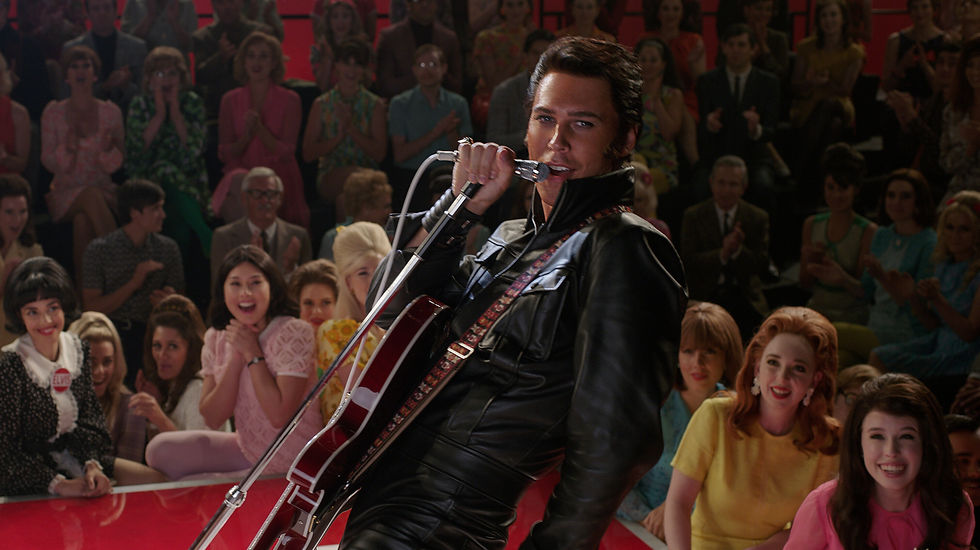
Opening in Las Vegas, 1997, “Elvis” starts off where its character’s stories end, we first meet Colonel Tom Parker, brought to life by a god-awful performance from Tom Hanks. The “Forrest Gump” star’s portrayal of the Dutch manager feels akin to some kind of supervillain much like Colin Farrell’s portrayal of The Penguin in Matt Reeves’ “The Batman”. As Parker tries to explain his involvement with Elvis and his rise to fame, he wanders through an empty casino in a dream-like sequence. We then finally get to meet Elvis himself in a thrilling Louisiana Hayride performance, introducing audiences to a career-best performance from Austin Butler. The American actor fully embodies Elvis, both physically and vocally, putting his all into the demanding role. As the film progresses, we see more of Parker and Elvis’ relationship as manager and star, and the king’s rise to astronomic fame, but also his detrimental downfall all the way up until his final performance in June 1977, only six weeks before his death.

“Elvis” is a film that feels very ‘Baz Luhrmann’, topfull of glittering flamboyance and the Australian director’s flashy style. But, while this may be a benefit for a film about someone like Elvis Presley, it ends up preventing the film from being as authentic as it could be. The absurd opening sequence where we are first introduced to Colonel Parker while he seems to be on his deathbed is wildly unnecessary, and in tandem with the various animations, ends up adding needless spectacle.

Even though “Elvis” takes place throughout the 50s, 60s, and 70s, Luhrmann modernises the film by including some of today’s most popular artists such as Doja Cat, Eminem, and Måneskin to name a few. The artists perform a mixture of renditions of Elvis’ own songs like “Can’t Help Falling in Love” and “If I Can Dream” and new songs written especially for the film like Doja Cat’s “Vegas”. The film also shows where Elvis’ got the inspiration for his music, including Black musicians like B.B. King (portrayed by Kelvin Harrison Jr) and Little Richard (played by Alton Mason). While Luhrmann’s film does show where Presley got the inspiration for his award-winning music, his film fails to address the fact that Elvis was accused of stealing music from Black artists, choosing to sanitise it and paint it in a good light.

One of the film’s most prominent issues arises from the screenplay, which becomes a jumbled mess that ends up restraining Austin Butler’s performance from being as good as it could be, and resulting in the third act being one of the only redeemable parts of the film. While “Elvis” does cover Presley’s life from childhood to adulthood, the film splits its focus between Elvis and his manager Colonel Parker, this would seem an unfortunate decision that results in the film feeling like an inadequate biopic of the man who the film is literally named after. Also, with a runtime nearing three-hours (159-minutes) the film ends up feeling hugely exhausting, amplified by the jumpy, fast-paced editing.

“Elvis” is a film that could’ve been one of the strongest films of 2022 as a glitzy retelling of the life of one of the biggest cultural icons of the 20th century. However, script issues, a ridiculous performance by Tom Hanks, and a paltry surface level look at multiple parts of Elvis’ life prevent it from reaching its full potential. Baz Luhrmann’s first film in nine years may have striking visuals and strong directing, but it ends up becoming a film with irredeemable issues that not even Austin Butler’s knockout performance can save.


Comments